What Causes Macular Degeneration and How to Recognize Its Symptoms
anushka
23 August 2026
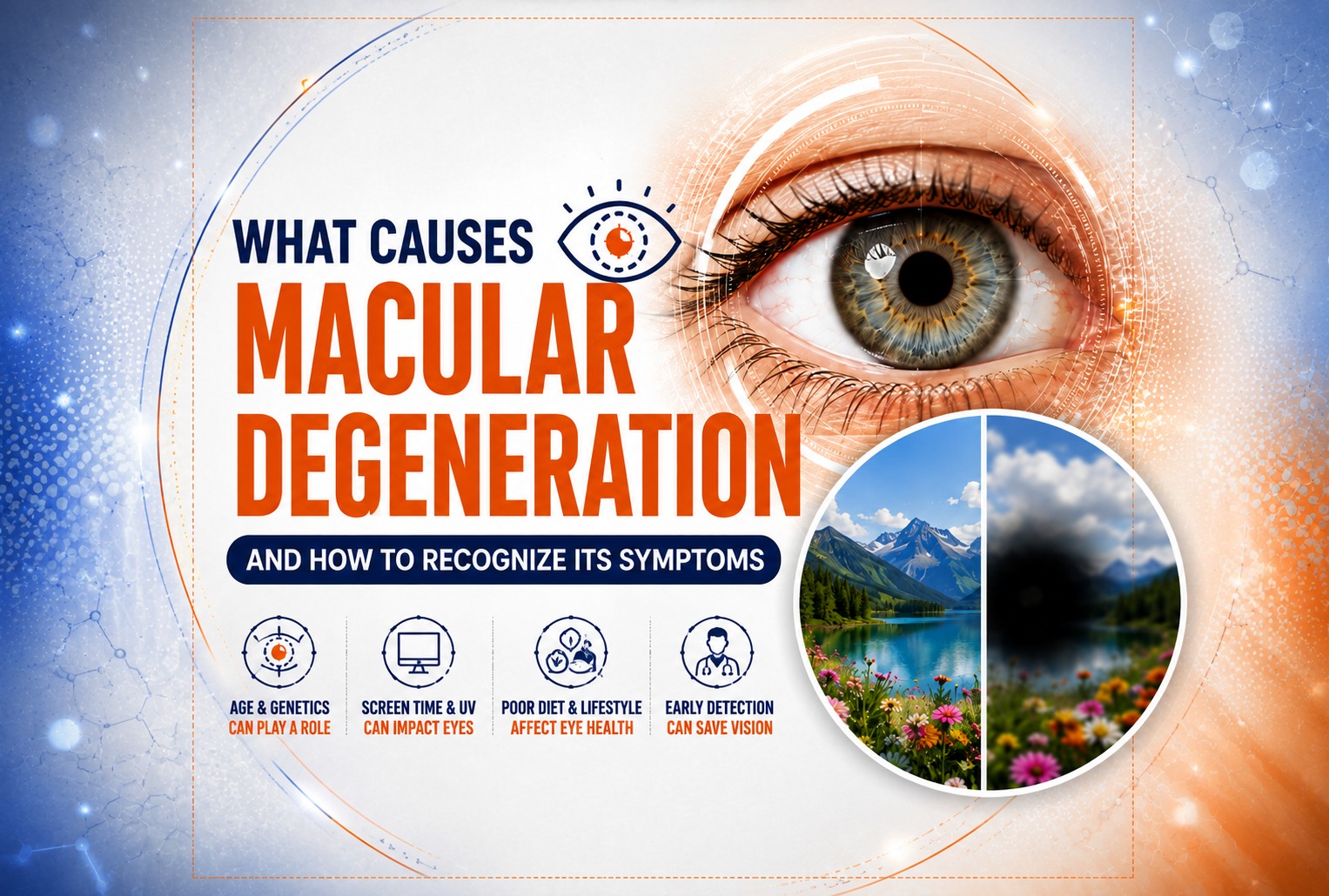
Imagine trying to read a book, recognize a loved one’s face, or drive a car, only to find that the center of your vision appears blurry or distorted. This is often how macular degeneration affects people. It is one of the leading causes of vision loss among older adults and can significantly impact daily activities and quality of life.
Macular degeneration primarily affects the macula, a small but critical part of the retina responsible for sharp, detailed central vision. While it usually does not cause complete blindness, it can make tasks such as reading, driving, using a smartphone, and recognizing faces extremely difficult.
The good news is that early detection and timely treatment can slow disease progression and help preserve vision. Understanding the causes, symptoms, and risk factors of macular degeneration is the first step toward protecting your eyesight.
In this comprehensive guide, we explore everything you need to know about macular degeneration and how to recognize its warning signs.
What Is Macular Degeneration?
Macular degeneration, also known as Age-Related Macular Degeneration (AMD), is an eye condition that damages the macula.
The macula is located at the center of the retina and is responsible for:
- Reading
- Recognizing faces
- Seeing fine details
- Driving safely
- Color perception
- Central vision clarity
When the macula becomes damaged, central vision gradually deteriorates while peripheral (side) vision often remains intact.
Understanding the Retina and Macula
The retina is a light-sensitive layer located at the back of the eye.
Its job is to:
- Capture light
- Convert light into electrical signals
- Send visual information to the brain through the optic nerve
The macula occupies only a small portion of the retina but is responsible for the majority of our detailed vision.
Even minor damage to the macula can significantly affect visual quality.
Types of Macular Degeneration
There are two primary forms of macular degeneration.
1. Dry Macular Degeneration
Dry AMD is the most common type, accounting for approximately 85–90% of cases.
It occurs when:
- Light-sensitive cells gradually break down
- The macula becomes thinner
- Small yellow deposits called drusen accumulate beneath the retina
Vision loss tends to be gradual.
Characteristics of Dry AMD
- Slow progression
- Gradual central vision loss
- Presence of drusen
- Usually affects both eyes
2. Wet Macular Degeneration
Wet AMD is less common but more serious.
It develops when abnormal blood vessels grow beneath the retina and macula.
These vessels may:
- Leak blood
- Leak fluid
- Cause retinal swelling
- Lead to rapid vision loss
Without prompt treatment, wet AMD can cause severe visual impairment.
What Causes Macular Degeneration?
The exact cause of macular degeneration is not fully understood.
However, researchers believe that a combination of aging, genetics, environmental factors, and lifestyle habits contributes to the disease.
1. Aging
Age is the most significant risk factor.
As we grow older:
- Retinal cells become less efficient
- Waste products accumulate
- Cellular repair mechanisms weaken
- Oxidative damage increases
Most cases occur in people over the age of 50.
Risk increases substantially after age 60.
2. Genetics and Family History
Macular degeneration often runs in families.
Several genes have been linked to AMD.
If a parent or sibling has macular degeneration, your risk may be significantly higher.
A family history does not guarantee that you will develop the disease, but it increases susceptibility.
3. Smoking
Smoking is one of the strongest modifiable risk factors.
Tobacco smoke damages retinal tissues through:
- Reduced oxygen supply
- Increased oxidative stress
- Blood vessel damage
Studies show smokers are considerably more likely to develop AMD than non-smokers.
4. High Blood Pressure
Healthy retinal function depends on adequate blood circulation.
Poorly controlled hypertension can:
- Damage retinal blood vessels
- Reduce oxygen delivery
- Increase AMD risk
Managing blood pressure benefits both eye health and overall health.
5. Obesity
Excess body weight has been associated with faster progression of macular degeneration.
Obesity may contribute through:
- Chronic inflammation
- Vascular damage
- Increased oxidative stress
Maintaining a healthy weight may help reduce risk.
6. Poor Diet
A diet lacking antioxidants and essential nutrients can increase vulnerability to retinal damage.
Nutrients important for macular health include:
- Lutein
- Zeaxanthin
- Vitamin C
- Vitamin E
- Zinc
- Omega-3 fatty acids
7. Excessive Sun Exposure
Long-term exposure to ultraviolet (UV) light may contribute to retinal damage.
Protective sunglasses with UV filters can help reduce exposure.
8. Cardiovascular Disease
Conditions affecting blood circulation may increase AMD risk.
Examples include:
- Heart disease
- High cholesterol
- Stroke
- Peripheral vascular disease
Healthy circulation supports retinal health.
Early Symptoms of Macular Degeneration
One of the challenges of AMD is that early stages may produce few noticeable symptoms.
Many people remain unaware until vision changes become significant.
Common Early Warning Signs
Blurred Central Vision
Objects directly in front may appear unclear.
Reading small print becomes difficult.
Difficulty Recognizing Faces
Facial features may appear less distinct.
People may become harder to identify from a distance.
Need for Brighter Light
Reading often requires stronger illumination than before.
Dim environments become more challenging.
Reduced Contrast Sensitivity
Colors may seem less vibrant.
Differences between similar shades become harder to distinguish.
Straight Lines Appear Distorted
A hallmark symptom of AMD is visual distortion.
Patients ay notice:
- Bent lines
- Wavy lines
- Uneven edges
This symptom is especially common in wet AMD.
Symptoms of Advanced Macular Degeneration
As the disease progresses, symptoms may become more noticeable.
Dark Spot in Central Vision
A blurred or dark area may develop in the center of vision.
This can interfere with reading and face recognition.
Severe Central Vision Loss
Patients may struggle with:
- Driving
- Reading
- Cooking
- Using electronic devices
Peripheral vision often remains relatively normal.
Visual Distortion
Objects may appear:
- Crooked
- Warped
- Smaller or larger than normal
How Is Macular Degeneration Diagnosed?
Regular eye examinations are essential for early detection.
An ophthalmologist may perform several tests.
Dilated Eye Examination
Special drops enlarge the pupils, allowing detailed retinal evaluation.
The doctor can identify:
- Drusen deposits
- Retinal damage
- Abnormal blood vessels
Optical Coherence Tomography (OCT)
OCT provides high-resolution cross-sectional images of the retina.
It helps detect:
- Fluid accumulation
- Retinal swelling
- Macular thinning
OCT has become one of the most important tools for AMD diagnosis and monitoring.
Amsler Grid Test
This simple grid helps identify visual distortion.
Patients with AMD may notice:
- Missing areas
- Wavy lines
- Distorted squares
Fluorescein Angiography
A special dye is injected into the bloodstream.
Photographs reveal abnormal retinal blood vessels and leakage.
This test is particularly useful for wet AMD.
Treatment Options for Macular Degeneration
Treatment depends on the type and severity of AMD.
Treatment for Dry AMD
Currently, no cure exists for dry AMD.
Management focuses on slowing progression.
Nutritional Supplements
Certain patients benefit from AREDS-based supplements containing:
- Vitamin C
- Vitamin E
- Zinc
- Copper
- Lutein
- Zeaxanthin
These may reduce the risk of progression in intermediate AMD.
Treatment for Wet AMD
Wet AMD requires prompt treatment.
Anti-VEGF Injections
These medications help:
- Reduce abnormal blood vessel growth
- Prevent leakage
- Stabilize vision
- Improve visual outcomes
Commonly used treatments include anti-VEGF injections administered directly into the eye.
Laser Therapy
Selected cases may benefit from laser treatment to seal abnormal vessels.
Photodynamic Therapy
This specialized treatment combines medication with laser activation to target abnormal blood vessels.
Can Macular Degeneration Be Prevented?
Although AMD cannot always be prevented, certain lifestyle changes may lower risk.
Stop Smoking
One of the most effective preventive measures.
Eat a Healthy Diet
Include:
- Green leafy vegetables
- Fish rich in omega-3
- Fruits
- Nuts
Exercise Regularly
Supports cardiovascular and retinal health.
Control Blood Pressure
Healthy circulation benefits the retina.
Wear UV-Protective Sunglasses
Protects eyes from excessive sunlight exposure.
Get Regular Eye Checkups
Early diagnosis allows timely intervention.
Living With Macular Degeneration
Many individuals continue to lead active lives despite AMD.
Helpful strategies include:
- Magnifying devices
- Large-print books
- Enhanced lighting
- Electronic reading aids
- Vision rehabilitation programs
Modern treatments have significantly improved outcomes for many patients.
Frequently Asked Questions
Can macular degeneration cause complete blindness?
AMD usually affects central vision but rarely causes total blindness because peripheral vision often remains intact.
Is macular degeneration hereditary?
Yes. Family history increases risk significantly.
Can AMD be cured?
Currently, there is no cure, but treatments can slow progression and preserve vision.
At what age does AMD usually occur?
Most cases occur after age 50, with risk increasing as people get older.
How often should I have eye examinations?
Adults over 50 should undergo regular comprehensive eye examinations, especially if they have risk factors.
Conclusion
Macular degeneration is a common age-related eye condition that can significantly affect central vision and daily activities. While aging remains the primary risk factor, genetics, smoking, poor diet, cardiovascular disease, and other lifestyle factors also contribute to its development.
Recognizing early symptoms such as blurred central vision, distortion, and difficulty reading can lead to earlier diagnosis and better outcomes. With modern diagnostic tools like OCT and advanced treatments such as anti-VEGF injections, many patients can preserve useful vision for years.
Regular eye examinations remain the most important step in protecting your sight.
About Anushka Eye Hospital
At Anushka Super Specialty Eye Hospital, Bhiwandi, we offer advanced retinal evaluation, OCT imaging, macular degeneration screening, retina consultations, and modern treatment options for retinal diseases.
Our experienced eye specialists are dedicated to helping patients detect retinal conditions early and preserve their vision through personalized care and advanced technology.
Book your comprehensive retina check-up today and safeguard your vision for the future.