Firecracker Eye Burns During Diwali: Immediate First Aid and Steps to Take After an Injury
anushka
6 November 2026
Why Diwali Is a High-Risk Time for Your Eyes
If a firecracker has hit your eye, rinse it with clean running water right away and get to an eye hospital. Do not rub it. Every minute matters, and the first few minutes of care often decide how much vision you keep.
Diwali is the festival of lights, but it is also the season when eye hospitals across India see a sharp rise in emergency cases. Crackers explode close to the face, sparks fly unpredictably, and chemical residue, hot fragments and shock waves can all hurt the eye in seconds. Children and teenagers are hurt most often, but a large share of injuries happen to bystanders who were only watching.
This guide explains the common types of firecracker eye injuries, the exact first aid steps to take at home, the mistakes that make injuries worse, and how to prevent them. Share it with your family before the celebrations begin.
Common Types of Firecracker Eye Injuries
Knowing what kind of injury you are dealing with helps you act correctly, although you should always get every injury checked by an eye doctor.
|
Injury type |
What happens |
Typical signs |
|
Chemical burn |
Gunpowder residue and chemicals splash or settle in the eye |
Intense burning, watering, redness, blurred vision |
|
Thermal burn |
Sparks or hot fragments burn the eyelids, surface of the eye or surrounding skin |
Pain, swelling, blistered or darkened skin around the eye |
|
Corneal abrasion |
A scratch on the clear front surface of the eye |
Sharp pain, feeling of grit, light sensitivity, tearing |
|
Foreign body |
A fragment or particle lodges on or in the eye |
Irritation, redness, a visible speck, blurred vision |
|
Blunt trauma |
A blast wave or fragment strikes the eye and socket |
Swelling, bruising, bleeding inside the eye, vision loss |
|
Penetrating injury |
A sharp fragment pierces the eyeball |
Severe pain, bleeding, distorted pupil, object visible in the eye |
Penetrating injuries and deep chemical burns can cause permanent vision loss, so they are always emergencies.
Immediate First Aid: What to Do in the First Minutes
Stay calm and act in this order. Treat every firecracker eye injury as serious until a doctor says otherwise.
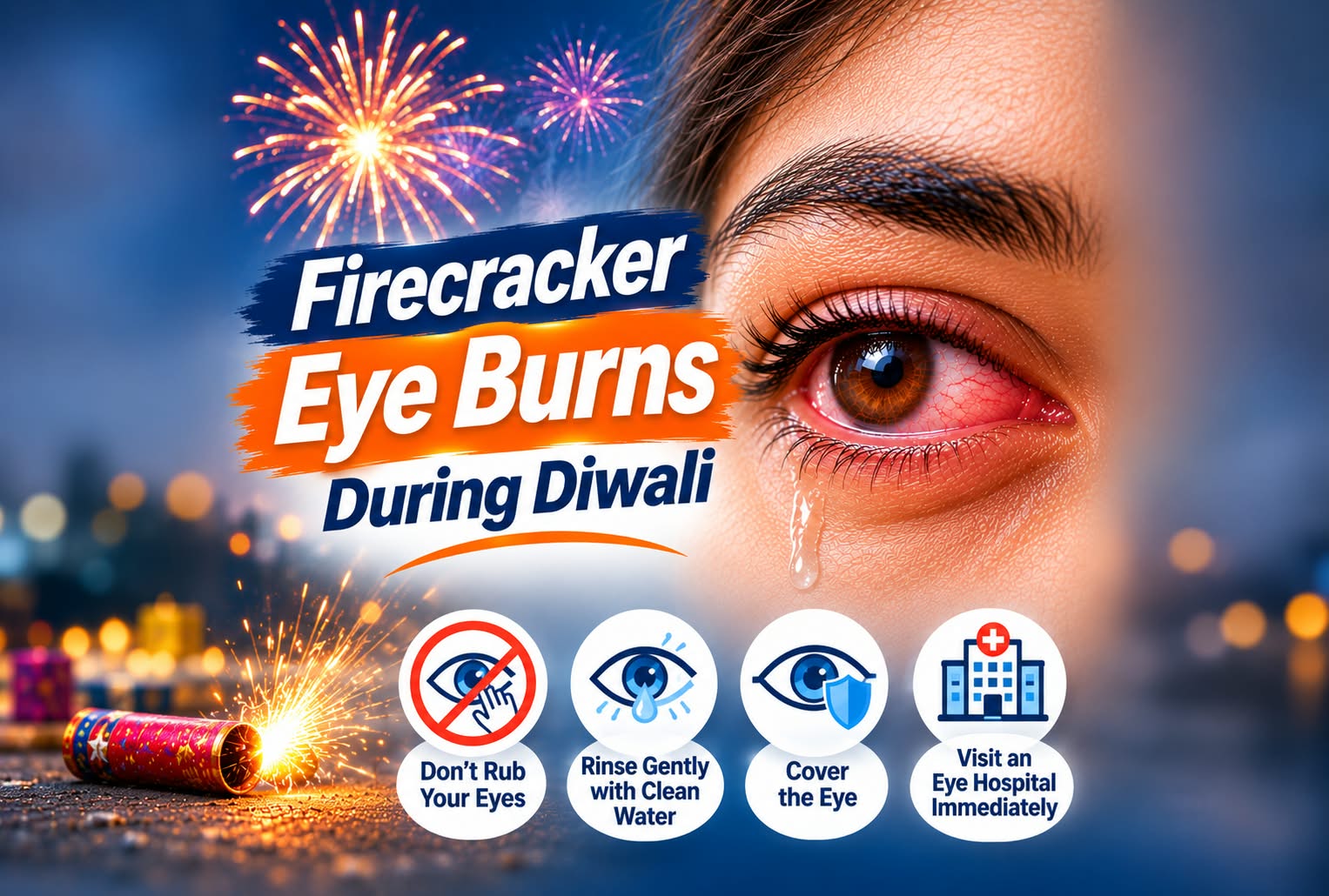
- Do not rub or press the eye. Rubbing can push particles deeper and turn a scratch into a deeper wound.
- Wash your hands if you can do so quickly, so you do not add germs to the eye.
- Flush the eye with clean running water for 15 to 20 minutes if you suspect a chemical burn, gunpowder residue or a small particle. Tilt the head so the water runs from the inner corner of the eye to the outer corner and does not wash into the other eye. Hold the eyelids open gently while flushing.
- Remove contact lenses if they come out easily during flushing. Do not force them.
- If something is stuck in the eye or has pierced it, do not flush and do not try to remove it. Cover the eye with a rigid shield, such as the bottom half of a clean paper cup taped around the eye. Do not press on the eyeball.
- For blunt injuries with swelling, apply a clean cold compress very gently to the area around the eye, with no pressure on the eyeball.
- Keep the person still and calm, with the head slightly raised. Crying and straining can raise pressure inside the eye.
- Go to the nearest eye hospital or emergency department immediately. Do not wait to see if it improves. Call 112 or arrange transport at once if you cannot travel safely.
If a child is hurt, keep them from rubbing the eye by holding their hands gently, and tell the doctor exactly what hit the eye and when.
What NOT to Do After a Firecracker Eye Injury
Well-meaning home remedies cause a lot of avoidable damage. Avoid these common mistakes:
- Do not rub, press or squeeze the eye.
- Do not use eye drops, ointments or medicines that you already have at home, unless a doctor has told you to.
- Do not put home remedies in the eye. Honey, milk, breast milk, rose water, oil, turmeric, tea bags and similar items can add germs and cause infection.
- Do not try to pull out an embedded object, however small it looks.
- Do not tilt the head so the water runs into the healthy eye while flushing.
- Do not bandage tightly or place any pressure on the eyeball.
- Do not delay. Do not wait for the redness or pain to fade, as some serious injuries hurt less after the first hour.
- Do not rely on a local pharmacy or a general clinic for a serious eye injury. See an ophthalmologist.
When to Rush to an Eye Hospital: Red-Flag Symptoms
Go to an eye hospital or emergency department straight away if you notice any of the following after a cracker injury, even if it seems minor:
- Sudden blurred, dim or lost vision
- Severe or worsening pain that does not ease
- Bleeding in or around the eye, or blood visible inside the eye
- A pupil that looks irregular, teardrop shaped or different in size from the other
- An object stuck in the eye or the eyeball looking cut or deformed
- Double vision, flashes of light or a curtain-like shadow
- Intense light sensitivity or constant tearing
- Swelling that stops you opening the eye, or burns on the eyelids and face
- A feeling that something is still in the eye after flushing
Some signs appear hours or days later, so see a doctor even if the pain settles. Chemical burns and internal injuries can worsen quietly. Early treatment lowers the risk of infection, scarring, glaucoma, cataract and permanent vision loss.
What to Expect at the Eye Doctor
An ophthalmologist will begin by asking what hit the eye, when it happened and what first aid you gave. Tell them everything, including anything you put in the eye.
- Examination: the doctor checks vision, uses a slit lamp microscope to inspect the surface and inside of the eye, and may use a special dye to show scratches or burns.
- Tests: for blunt or penetrating injuries, a CT scan or ultrasound may be needed to look for fragments or damage behind the eye.
- Treatment: depending on the injury, this can include further flushing, prescribed antibiotic and anti-inflammatory drops, medicines to ease pain and swelling, a protective patch or lens, removal of particles, or emergency surgery for deep injuries.
- Follow-up: you will usually need repeat visits to check healing, as some complications such as infection, raised eye pressure or scarring develop later.
Follow the prescribed drops and schedule exactly, do not stop early even if the eye feels better, and avoid rubbing, swimming, dusty places and screen strain until the doctor says it is safe. Recovery can take days or weeks, and serious injuries may need long-term care.
Prevention: Keeping Your Eyes Safe This Diwali
Nearly every firecracker eye injury can be prevented. Build these habits into your celebration.
- Wear protective eyewear such as safety goggles or clear glasses when lighting or standing near crackers. Regular spectacles and sunglasses give limited protection.
- Keep a safe distance and never bend over a cracker to light it or check on it.
- Supervise children closely. Young children should not handle crackers at all, and teenagers should use them only with an adult present.
- Protect bystanders. Spectators are often hurt by crackers they did not light, so keep onlookers well back.
- Choose lower-risk options such as flower pots (anars) with care, and avoid rockets, bombs and homemade or illegal crackers, which can fly sideways or explode unpredictably.
- Never aim crackers at people, animals or buildings, and never light them in confined spaces.
- Do not lean over or pick up a cracker that failed to go off. Douse it in water first.
- Avoid wearing contact lenses while handling crackers, as they can trap particles against the eye.
- Keep a first aid kit and clean water ready, and save the number of the nearest eye hospital on your phone before Diwali begins.
- Know your emergency numbers: call 112 for emergency help across India, and 108 or 102 for an ambulance where those services run in your state.
Frequently Asked Questions
What should I do first if a firecracker hits my eye?
Do not rub it. Flush the eye with clean running water for 15 to 20 minutes if you suspect chemicals or small particles, then go to an eye hospital straight away. If an object is stuck in the eye, cover it with a rigid shield and do not flush.
Can I use eye drops after a cracker injury?
No. Do not use any drops or ointments at home unless an eye doctor has advised them. Drops can hide symptoms, contain the wrong medicine or cause an infection.
How long should I wash the eye with water?
For a suspected chemical burn or gunpowder residue, flush continuously for 15 to 20 minutes, and keep going on the way to hospital if you can.
Is it safe to use milk, honey or rose water on the eye?
No. Home remedies can introduce bacteria and make the injury worse. Use only clean running water for flushing.
Should I see a doctor if the pain goes away?
Yes. Some serious injuries, such as chemical burns and internal eye damage, hurt less at first but worsen over hours or days. Always get a professional check.
Can a firecracker cause permanent blindness?
Yes, severe injuries can cause permanent vision loss, which is why immediate first aid and urgent treatment are so important. Many injuries heal well when treated early.
Do sunglasses or spectacles protect against firecracker injuries?
They offer limited protection. Proper safety goggles that fit closely are better, and keeping a safe distance is the best protection.
Who should I call in an emergency in India?
Call 112 for emergency help, and use 108 or 102 for an ambulance where those services are available. Contact the nearest eye hospital as well.
Enjoy Diwali, Protect Your Vision
A firecracker eye injury takes a second to happen and can change a life, but fast, correct first aid and prompt treatment save many eyes. Flush with clean water, do not rub or medicate, shield the eye if something is stuck, and get to an ophthalmologist immediately.
Better still, prevent it. Wear eye protection, keep your distance, supervise children and choose a safer, quieter celebration. Share this guide with your family, friends and neighbours before Diwali so that everyone knows what to do.